
How Downspout Placement Affects Both Drainage and Curb Appeal on Houston Homes
Home / Blog

Recent Blog
-
How Downspout Placement Affects Both Drainage and Curb Appeal on Houston Homes
-
Installing Gutters on Homes with Covered Porches in Houston
-
Gutter Solutions for Homes with Multiple Roof Planes in Houston
-
How to Match Your Gutter Color and Style to a Luxury Home's Exterior in Houston
-
Why New Houston Homes Need a Gutter Inspection Before Landscaping Is Installed
Ready to Transform Your Property? Contact Us Today
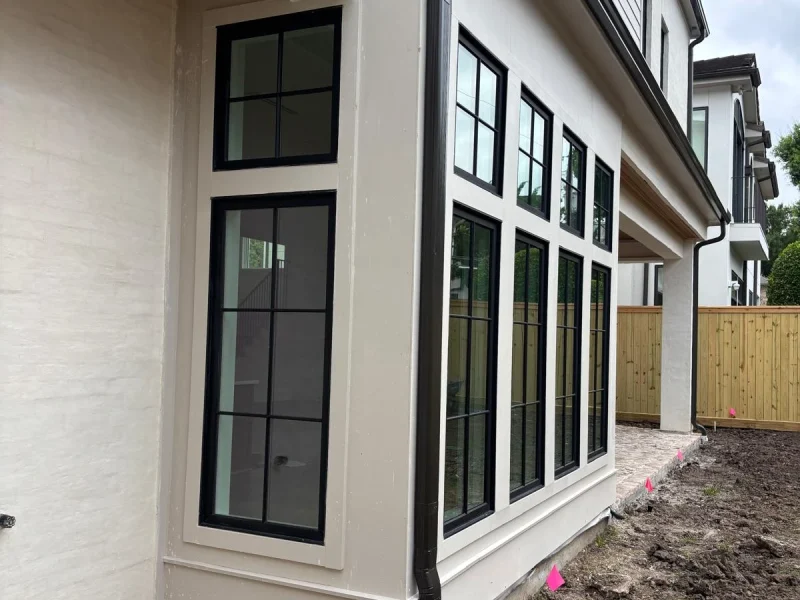
When most Houston homeowners think about their gutter system, they focus on the gutters themselves — the horizontal runs along the roofline that collect rainfall and move it toward a discharge point. But the downspouts that carry that water from the gutter to the ground are equally important, and the decisions made about where to place them affect two things simultaneously: how well your home drains during a Houston rainstorm, and how your home looks from the street every single day.
Getting downspout placement right means solving both problems at once — and on a well-designed Houston home, the two goals reinforce each other rather than competing.
The Drainage Function of Downspout Placement
Before considering aesthetics, downspout placement needs to satisfy a set of functional requirements that are non-negotiable in Houston’s high-rainfall environment.
Distributing Water Load Evenly Across the Roofline
Every downspout serves a specific section of the gutter run above it. If downspouts are spaced too far apart, the gutter sections between them fill up faster than they can drain during a heavy Houston storm — leading to overflow at the midpoints between downspouts rather than at the discharge points where the water is supposed to exit.
A general rule of thumb is one downspout for every 30 to 40 linear feet of gutter run. In Houston, where rainfall intensity during storm events regularly exceeds what most gutter systems are designed for, erring toward more frequent downspout placement — one per 25 to 30 feet on exposed rooflines — provides a meaningful margin of safety during peak rainfall.
Positioning Discharge Points Away from the Foundation
Every downspout needs to terminate in a location where the water it carries can move away from the home’s foundation rather than pooling against it. This means:
- Discharge points positioned at least 4 to 6 feet from the foundation perimeter
- Termination toward yard areas that slope away from the home
- Avoidance of discharge points near window wells, basement entries, or low spots in the yard that collect water naturally
In Houston’s clay-heavy soil environment, a downspout that discharges even marginally too close to the foundation contributes to the soil saturation and expansion cycle that causes foundation cracking and shifting over time.
Accounting for Corner and Valley Discharge
Corners and roof valleys are high-volume discharge points where water from two roof sections converges before entering the gutter. Downspouts at or near these points need to be sized and positioned to handle the combined volume — not just the average flow from a single roof section. Placing a downspout directly below a valley or at a corner where two gutter runs meet is one of the most important drainage decisions in the entire installation.
The Curb Appeal Function of Downspout Placement
Once the drainage requirements are satisfied, downspout placement becomes a design decision — and on a modern Houston home where exterior aesthetics are carefully considered, it’s a decision that deserves the same attention as any other architectural detail.
Working With the Home’s Vertical Lines
Downspouts are vertical elements, and they read most naturally when they align with — or deliberately respond to — the other vertical elements on the home’s facade. On a home with strong vertical window frames, columns, or architectural reveals, a downspout positioned at a corner or alongside a structural element looks intentional. One placed randomly in the middle of a flat wall section draws the eye precisely because it has no visual logic behind it.
Using Color to Integrate or Accent
The color relationship between the downspout and the home’s exterior is one of the most visible gutter decisions a homeowner makes — and one of the most frequently underestimated.
- Matching the downspout to the fascia or trim creates a seamless look where the downspout recedes visually into the roofline and wall rather than standing out as a separate element.
- Coordinating the downspout with window frames and other dark accents — as seen on modern Houston homes with matte black window frames — creates a cohesive exterior palette where the downspout reads as a deliberate design element rather than a functional addition.
- Mismatched colors between the downspout body and its extensions or elbows create a fragmented, unfinished appearance that undermines the quality of the overall installation — a detail that’s immediately visible at eye level from the street or the yard.
Minimizing Visibility on Feature Elevations
On the front elevation of a Houston home — the face that neighbors, visitors, and potential buyers see first — downspout placement should minimize visual interruption of the facade wherever drainage requirements allow. This often means:
- Positioning downspouts at corners rather than centered on wall sections
- Running downspouts alongside architectural elements that provide visual cover
- On homes with wrapping porches or covered entries, routing downspouts behind columns where they’re visible only from angles rather than head-on
The side and rear elevations of the home offer more flexibility — downspouts there can prioritize drainage efficiency without the same curb appeal constraints that apply to the front.
When Drainage Requirements and Aesthetics Conflict
On most Houston homes, thoughtful planning resolves the apparent tension between drainage needs and visual preferences without compromise. But occasionally a home’s drainage requirements genuinely conflict with the ideal aesthetic placement — a valley discharge point that lands in the middle of the front facade, for example, or a corner that drains perfectly but sits directly beside the main entry.
In those situations, there are several approaches that preserve both function and appearance:
- Underground downspout connections that carry water from a visually sensitive discharge point to a remote outlet well away from the foundation and out of sight entirely
- Decorative downspout profiles in finishes that complement premium exterior materials — round downspouts in matte black or bronze, for example, read as architectural details rather than utility components
- Strategic landscaping coordination where discharge points are positioned to work with planned planting beds and hardscaping that naturally conceal the termination point while managing the water
Every Downspout Decision Is a Permanent One
Unlike gutters, which can be adjusted or repositioned with relative ease, downspout placement involves penetrations through the fascia and termination points in the ground that become fixed features of the home. Getting the placement right during installation — rather than correcting it afterward — is the approach that protects both the drainage performance and the curb appeal of the home for years to come.
At Mairena Gutter Services LLC, we plan every downspout installation with both drainage performance and exterior aesthetics in mind — because on a Houston home, both matter from day one.
Contact us today or book your free estimate and let us design a gutter system that works for every part of your home — porch included.