
Installing Gutters on Homes with Covered Porches in Houston
Home / Blog

Recent Blog
-
How Downspout Placement Affects Both Drainage and Curb Appeal on Houston Homes
-
Installing Gutters on Homes with Covered Porches in Houston
-
Gutter Solutions for Homes with Multiple Roof Planes in Houston
-
How to Match Your Gutter Color and Style to a Luxury Home's Exterior in Houston
-
Why New Houston Homes Need a Gutter Inspection Before Landscaping Is Installed
Ready to Transform Your Property? Contact Us Today
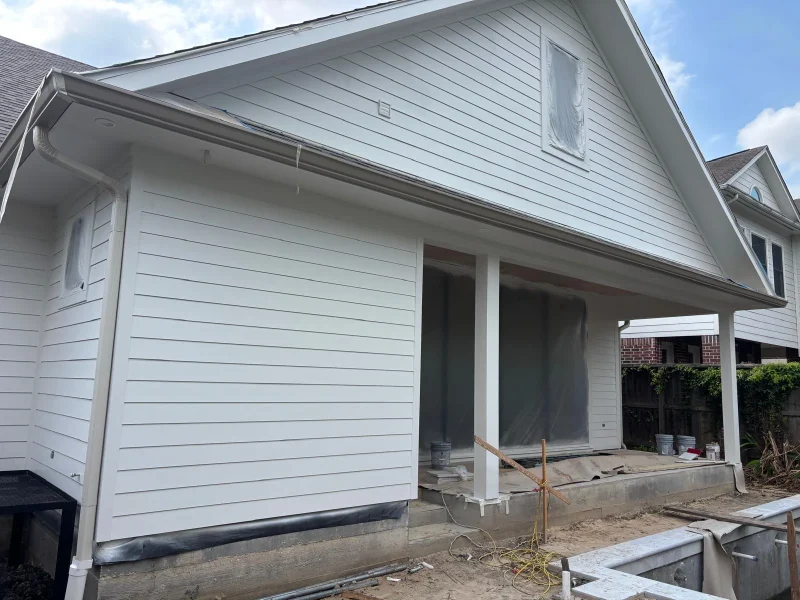
A covered porch adds tremendous value to a Houston home — it extends living space, enhances curb appeal, and provides shade during the city’s long, hot summers. But a porch also adds complexity to your home’s drainage system that many homeowners and even some contractors underestimate.
When a covered porch is attached to the main structure, it creates its own roof section with its own drainage needs — and if those needs aren’t addressed correctly during gutter installation, the porch becomes a source of water damage rather than a source of enjoyment. In Houston’s high-rainfall environment, getting porch gutter installation right from the start is essential.
Why Covered Porches Create Unique Drainage Challenges
A covered porch isn’t just an aesthetic addition — it’s a structural extension of the home that intercepts rainfall and needs to direct it somewhere. Without a properly integrated gutter system, that water has only a few places to go — and none of them are good for your home.
- Water falls directly off the porch roofline onto the steps, walkway, and soil immediately surrounding the foundation — exactly where you want it least.
- The transition point between the main roof and the porch roof becomes a concentrated discharge zone where water from the upper roof lands on the lower porch roof before flowing off its edge.
- Porch columns and posts are at constant risk of moisture exposure at their base when water drips off an unguttered porch edge and pools around their footings.
- The foundation beneath and around the porch slab is particularly vulnerable to water saturation when porch drainage isn’t directed away from the structure.
- Adjacent siding and fascia on the main home can be damaged by splash-back from water hitting an unguttered porch edge at full force during heavy Houston rainstorms.
The Two Drainage Systems a Porch Home Needs
One of the most important things to understand about gutter installation on a home with a covered porch is that the porch and the main roofline are two separate drainage systems — and both need to be addressed.
- The Main Roof System
The primary gutter system follows the roofline of the main home, collecting rainfall from the upper roof and directing it through downspouts to appropriate discharge points away from the foundation. On a two-story home with a porch, this system needs to account for the fact that water from the upper roof may discharge onto the porch roof below before reaching the main gutters.
- The Porch Roof System
The porch roof requires its own dedicated gutter run along its outer edge — the side facing the yard or street — to collect both the rainfall that lands directly on the porch roof and any water that cascades down from the main roof above. This porch gutter run needs its own downspout, positioned to direct water away from the porch slab, foundation, and column footings.
Treating these as two separate but coordinated systems — rather than one continuous installation — is the key to getting porch drainage right.
Key Installation Considerations for Porch Gutters in Houston
- Sizing for Combined Water Volume
The porch gutter run often needs to handle more water than its physical size might suggest — particularly where the main roof discharges onto the porch roof before that water flows into the porch gutter. In Houston, where rainfall intensity during storm events can be extreme, sizing the porch gutter to handle combined upper and lower roof volume is essential to preventing overflow.
In most cases, 6-inch seamless gutters on the porch roofline are the appropriate choice for Houston homes — providing the capacity to manage combined flow without overflowing during the city’s heaviest rain events.
- Downspout Positioning Around Porch Columns
Porch columns present both a design challenge and a practical constraint for downspout placement. Downspouts need to be positioned in locations that direct water efficiently away from the foundation and column footings — but they also need to work around the architectural layout of the porch without creating visual clutter or safety hazards.
On most Houston homes, porch downspouts work best at the outer corners of the porch, well away from the main entry steps and positioned to discharge water toward the yard rather than toward the walkway or driveway.
- Coordinating the Transition Between Roof Levels
Where the main roof meets the porch roof — the transition zone between upper and lower structures — careful detailing is required to ensure water from above is directed cleanly onto the porch roof and into the porch gutter rather than behind it or against the wall.
This transition point is one of the most common locations for water intrusion on homes with covered porches, and it deserves particular attention during both installation planning and post-installation inspection.
- Gutter Color Coordination Across Both Systems
On a home where gutters are color-matched to the exterior — as is ideal for curb appeal and visual consistency — the porch gutter system needs to match the main roof gutter system exactly. Both runs should use the same profile, the same material, and the same color so that the two systems read as one unified installation rather than two mismatched additions.
Common Mistakes to Avoid on Porch Gutter Installations
Even experienced contractors occasionally make decisions on porch gutter installations that create problems down the road. Here are the most common ones to watch for:
- Installing gutters only on the main roofline and leaving the porch unguttered — a common shortcut that leaves the porch, its columns, and the surrounding foundation unprotected.
- Undersizing the porch gutter without accounting for water volume from the upper roof cascading onto the lower porch roof.
- Positioning porch downspouts too close to column footings — creating moisture exposure at the base of structural elements.
- Failing to seal the transition point between the main roof and porch roof, allowing water to migrate behind the gutter and into the fascia or wall cavity.
- Mismatching gutter profiles or colors between the main system and the porch system, creating a visually inconsistent exterior.
Complete Gutter Solutions for Houston Homes with Porches
At Mairena Gutter Services LLC, we design and install complete gutter systems for Houston homes with covered porches — addressing both the main roofline and the porch as the coordinated drainage system they need to be. From sizing and downspout placement to color matching and transition detailing, our team handles every element of the installation so that your porch stays dry, your foundation stays protected, and your home’s exterior looks exactly the way it should.
Contact us today or book your free estimate and let us design a gutter system that works for every part of your home — porch included.